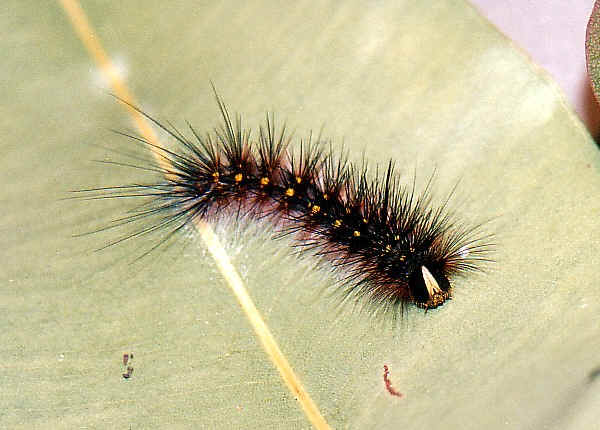
Moths - Order Lepidoptera
This page contains pictures and information about Moths and Caterpillars that we found in
the Brisbane area, Queensland, Australia.
 - Looper Moth, wingspan 50mm
-
-
-
- Butterflies and Moths are closely related insects which are classified
together as one Lepidoptera order, meaning 'scaly wings'. All of them have
scales on wings. The colour of
the butterflies and moths are formed by the scales which cover the wings. Those scales
will come off easily and this is considered as an evolved weapon against the
Spider's web. Another feature of butterflies and moths are their mouths, or their
proboscis, that curl up under the heads. Their proboscis can be extended and
inserted into the flowers to suck up liquid food.
-
- Most butterflies are colourful and fly by day while most moths are dull in
colour and active at night. However there are some exceptions, a few species of
moths are day flying and as colourful as butterflies. The major different
between butterflies and moths are when at rest, most butterflies hold their
wings upright over their back while the moths usually hold their wings
open and flat. Their antennae are also different. Most butterflies have their
antennae smooth and straight, with a 'club' at the end. Moths have their
antennae without club and some are feather like.
-
-
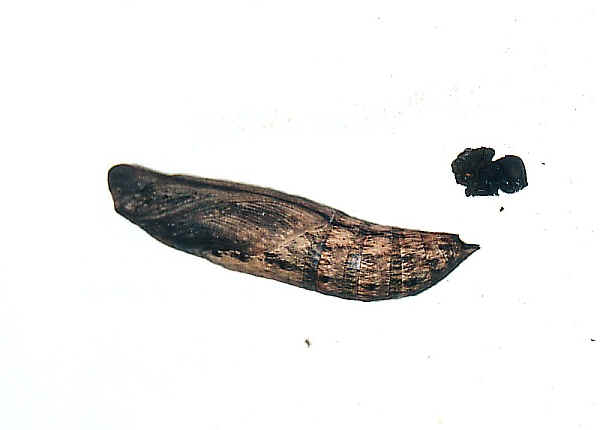
- Caterpillar Pupa
Scales on wing
-
- Moths are much more diverse than butterflies in Brisbane and in the world.
Some of them we
found are not yet identified. Adults moths body size are range from 3mm to 60mm. The
larva, or caterpillar, with a head and soft thorax and usually 10- segmented
abdomen. They are complete
metamorphosis. The adults usually feed on nectar and pollen, while most caterpillars
feed on plant leaves, but some feed on wood or roots.
-
Classification :
  Family Psychidae
- Case Moths Family Psychidae
- Case Moths - Most
species the caterpillars live in a mobile case. The case is made of silk and
plants materials. Each species make case in different shapes. For some species, if it is a female, it will not develop wings
and will never come out of the bag. It just wait for a winged male in her
bag.
-
  Family Bucculatricidae
- Scribbly Gum Moths Family Bucculatricidae
- Scribbly Gum Moths- The larvae in this family are very small and we may not want to call them
caterpillars. They are usually leaf miners although the famous one in this
family is the under bark miner.
-
-
-
  Family Gracillariidae - Leaf Miners Family Gracillariidae - Leaf Miners
- The caterpillars in this family form tunnels and cavities in the spongy
layer between the upper and lower surfaces of leaves. Their adult moths are
slander and small in size. Their wings are narrows, with long hair along the
hind wing margins.
-
-
  Family Oecophoridae - Concealer Moths Family Oecophoridae - Concealer Moths
- In this family the caterpillar habits are diverse, but most are feed on Eucalyptus,
include live or dead materials. We only found one species in this family
.
-
-
-
  Family Xyloryctidae
- Timber Moths Family Xyloryctidae
- Timber Moths
In some reference, this group is put under family Oecophoridae as subfamily Xyloryctinae. Moths in Xyloryctidae are medium in size with stout body. They are usually partially white with checkered apical wing margin. As those moths in Oecophoridae, they have the upturn pointed stickle-shaped labial palpi in front of their head.
-
  Family Blastobasidae - Small Grey Moths Family Blastobasidae - Small Grey Moths- Blastobasidae is a small family. There are about 10 species in Australia and all of them are in genus Blastobasis. They are small dull grey moths. They rest with wings folded around body. The larvae feed on dead plant materials.
-
-
-
  Family Cosmopterigidae - Narrow-winged Moths Family Cosmopterigidae - Narrow-winged Moths
- Moths in this family are from very small to small in size. They are usually black, grey or white in colours. The labial palps are long and recurved. The wings are long and narrow. The larvae are borer in stems, seeds or forming galls. Some are predators of scale insects.
-
-
  Family Gelechiidae - Gelechid Moths Family Gelechiidae - Gelechid Moths
- Moths in family Gelechiidae are very small to small in size. They are dull colours with narrow wings. Their larvae live in joined leaves. They feed on seeds or mine in leaves and stems.
-
-
-
  Family Lecithoceridae - Long-horned Moths Family Lecithoceridae - Long-horned Moths
Moths in this family Lecithoceridae have antenna length as the body length, and the antenna are put in front when resting. The wings are hold flat above abdomen. They have lone upturned palpi. Larvae are hairy. It is believed that they feed on dead plant materials.
-
  Family
Cossidae - Wood Moth and Goat Moth Family
Cossidae - Wood Moth and Goat Moth- Moths in the family Cossidae are from large to very large size. They have
long and narrow wings like those of Hawk
moths. They are mostly brown or grey in colours. The adult moths in this
family do not feed so their mouth parts are largely reduced.
-
  Family
Tortricidae - Leafrollers, Bell Moths Family
Tortricidae - Leafrollers, Bell Moths - Some member of this family are called Leafrollers because their caterpillars
roll the leaves of their foodplant. They are sometimes called Bell Moths
because their adults have the shape of church bell.
-
-
  Family Castniidae - Sun Moths Family Castniidae - Sun Moths- They fly during the day and have clubbed antenna, but they are not
butterflies. They are Sun Moths. A family of moths that active during the day.
They usually have brown forewings but bright colour hind wings. Their
caterpillars are hardly be seen for they tunnel in soil.
-
  Family Choreutidae
- Metalmark Moths Family Choreutidae
- Metalmark Moths- Moths in this family are from very small to small size. They usually have
the metallic colours on broad wings and are active during the day. They rest
with their wings raised and curled. They walk with rapid jerky style. If
disturbed, they are readily to take off.
-
  Family
Zygaenidae - Forester Moths Family
Zygaenidae - Forester Moths- The moths in this family are from small to large size. They are usually
in metallic blue, green or black colours. They are active
during the day.
-
  Family
Limacodidae - Cup Moths
They are named 'Cup Moths' because the shape of their pupal cocoon look like a
cup. Most caterpillars have their stinging
hairs when disturbed, and they usually have the bright warning colours. Adults
have fat and furry bodies, from small to medium size.\ Family
Limacodidae - Cup Moths
They are named 'Cup Moths' because the shape of their pupal cocoon look like a
cup. Most caterpillars have their stinging
hairs when disturbed, and they usually have the bright warning colours. Adults
have fat and furry bodies, from small to medium size.\
  Family Pterophoridae - Plume Moths Family Pterophoridae - Plume Moths
This is a small moth family. Moths in family Pterophoridae are known as Plume Moths. Plume Moths are from small to medium in size. They are easily recognized. When rest, they hold out their wings hight and at right angle to their long thin body.
The caterpillars are usually with short hairs on body. -
  Family Hyblaeidae - Teak Moths Family Hyblaeidae - Teak Moths
Hyblaeidae is a small moth family. Moths in this family have strong thorax, small head and long palps. Caterpillars in family Hyblaeidae feed on leaves of teak (Verbenaceae) and Vitex (Bignoniaceae).
  Family
Crambidae - Crambid Moths
Their caterpillars have many different types of habits. Most are
concealed feeder, living in lives tied with silk, in silken webs or in leaf
cases jointed by silk. Some bore in stems or fruits while some live in plant
materials on ground or in soil. Family
Crambidae - Crambid Moths
Their caterpillars have many different types of habits. Most are
concealed feeder, living in lives tied with silk, in silken webs or in leaf
cases jointed by silk. Some bore in stems or fruits while some live in plant
materials on ground or in soil.
  Family
Pyralidae -
Pyralid Moths
Family PYRALIDAE was recently split into CRAMBIDAE and PYRALIDAE. In
general, moths in this two families rest with wings in triangular shape. They
are small in size and have relatively long legs. Family
Pyralidae -
Pyralid Moths
Family PYRALIDAE was recently split into CRAMBIDAE and PYRALIDAE. In
general, moths in this two families rest with wings in triangular shape. They
are small in size and have relatively long legs.
  Family Geometridae -
Looper Family Geometridae -
Looper - Most Caterpillars in this family only have
one or two pair of prolegs. They move with curving their bodies into loops and usually hairless and with slender body.
The moths have camouflaged wing patterns of wavy
lines extend across both fore and hind wings.
-
  Family Lasiocampidae - Snout Moths Family Lasiocampidae - Snout Moths
- The Caterpillars of this family are medium to large size. Most have a
pair of dorsal glands on abdomen. Many have flaps of skin overhanging their
prolegs and they like to lie along twigs. The adult moths are large and
stout, have elongated mouth parts.
-
  Family Anthelidae -
Anthelid Moths Family Anthelidae -
Anthelid Moths- The
Caterpillars are from medium to very large size. They are very hairy. Their
heads are large, and usually have the wearing sunglass look. ANTHELIDAE
moths fly at night. They have stout hairy body and board wings.
-
-
  Family Eupterotidae - Bag-shelter Moths Family Eupterotidae - Bag-shelter Moths
Eupterotidae is a small moth family and not common in Australia. Moths in this family are medium to large in size with board wings. They are furry moths with head and body covered with long hairs. Both female and male have bipectinate antennae. They are active at night.
-
 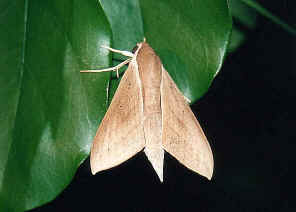 Family Sphingidae -
Hawk
Moths Family Sphingidae -
Hawk
Moths - Hawk Moths are large size moths. They have the strong and aerodynamic
-shaped body. Their forewings are narrow and long with smaller hind wings.
They are very good flyer. When at rest, they hold their wings on body like a
tent.
-
-
Superfamily NOCTUOIDEA
  Family
Notodontidae - Processionary Caterpillars Family
Notodontidae - Processionary Caterpillars- Most
Caterpillars of NOTODONTIDAE will raise their head and/or tail
when disturbed. Some of them are hairy but some are smooth with few spines.
They are usually colourful and active during the day.
-
-
 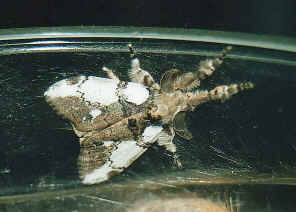 Family Lymantriidae -
Tussock Moths Family Lymantriidae -
Tussock Moths
- Their Caterpillars are also hairy, often with four distinct
tussocks of hair on their back make them look like a toothbrush. Moths in this family are small to medium size with hairy body.
They held
their board wings like roots over their abdomen at rest.
-
  Family Arctiidae - Tiger Moths Family Arctiidae - Tiger Moths- Most Caterpillars of the ARCTIIDAE are covered in dense
dark hairs. The caterpillars are small to
medium size.
The adults usually have
bright warning colour patterns, which are spotted in red, orange, black or
white. Their abdomen usually striped with black and yellow-red colour.
-
  Family Aganaidae - Tiger
Moths Family Aganaidae - Tiger
Moths- This family is very closely related with family Arctiidae and
sometimes put as its sub-family.
-
-
-
  Family Noctuidae -
Armyworms, Semi-Loppers and Owl Moths Family Noctuidae -
Armyworms, Semi-Loppers and Owl Moths
- Their Caterpillars are usually smooth
or with little hairs. They are from small to large size. The adults mainly fly at night. They usually feed on
nectar from flowers or ripe fruit. Most are dull in colour, but some have colourful hindwings.
-
-
- Other Moths and Others
Caterpillars
- There
are some Unknown Moths and Unknown Caterpillars
that yet to be identified. Please advise
if you can identify any of them.
- Here we would like to thank Don Herbison-Evans for his
kindly advices on the identity of some caterpillars and adults in our web site.
His Australian
Caterpillars web site is our major reference.
- Reference:
- 1. Insects
of Australia, CSIRO, Division of Entomology, Melbourne University
Press, 2nd Edition 1991, pp 817.
- 2. Insects of Australia and New Zealand - R. J. Tillyard, Angus
& Robertson, Ltd, Sydney, 1926, p396.
- 3. Caterpillars
of Australian Moths - Don Herbison-Evans & Stella Crossley, 2007
- 4. MOTH FAMILIES - Some Australian Moths from South-East Queensland, Ian McMillan, 2006.
- 5. Moths of Australia
- I. F. B. Common, Melbourne University Press, 1990.
- 6. Moths
of Australia - Bernard D'Abrera, Lansdowne Press, Melbourne, 1974.
- Back to Top
|