|
| |
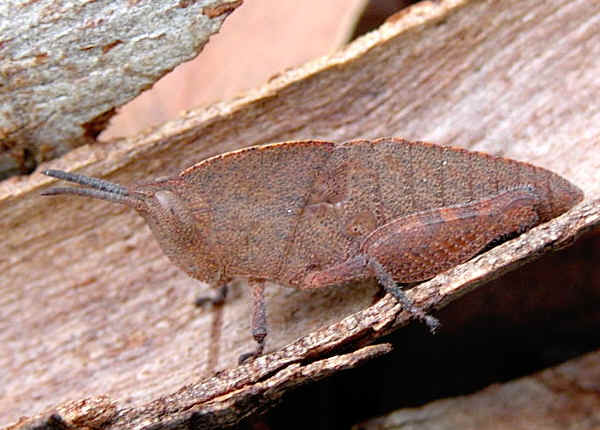
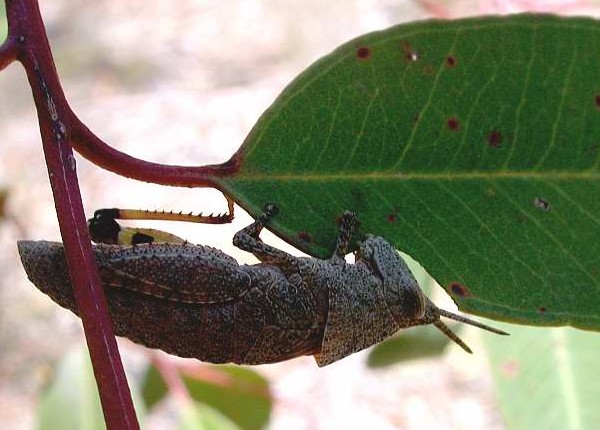
- This page contains pictures and information about Grasshoppers in Family ACRIDIDAE
that we found in the
Brisbane area, Queensland, Australia.
-
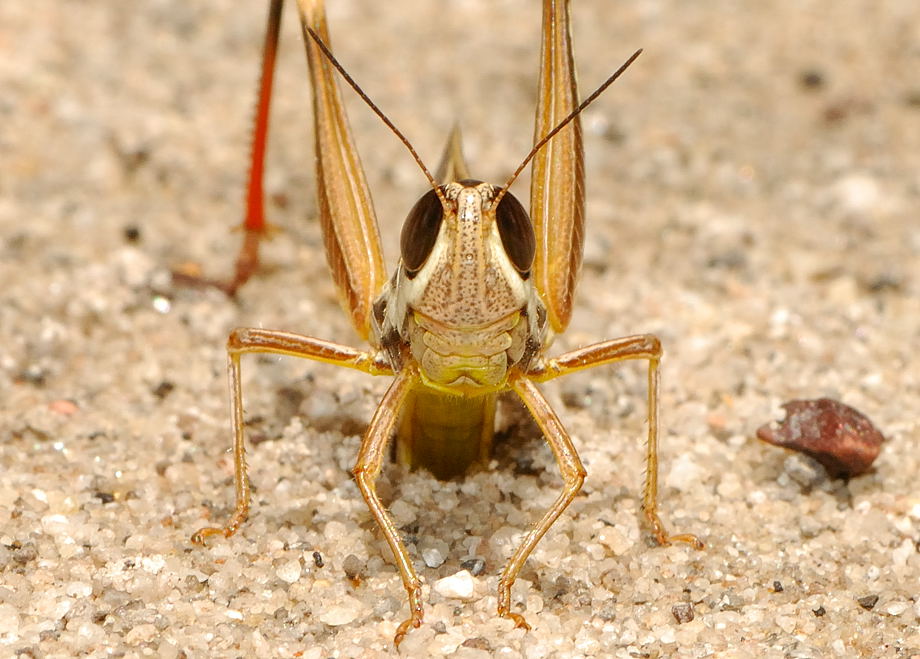 -
Female laying eggs under soil surface
-
- Member in this family are commonly called grasshoppers. All of them have
strong hind legs for jumping. They have short
antennae (less than 30 segments) and short ovipositor.
-
-
Members in this family usually have their wings well developed adults, although
quite a number species have reduced-wings and flightless. Most grasshoppers are
in camouflaged colours but a few of them are brightly
coloured. For some species the body colours very variable. However the
inside surface colours of hind legs can be useful for species
identification.
-
-
Males sing during day by rubbing legs against sides of their
forewings. Some species include a visual display of bright colours on legs or wings.
Females oviposit egg masses protected by a foamy substance, under soil or
in plants. Most of them have an annual life cycle.
-
-
 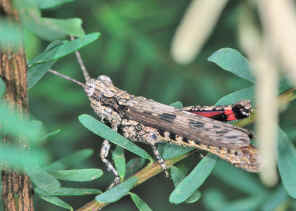 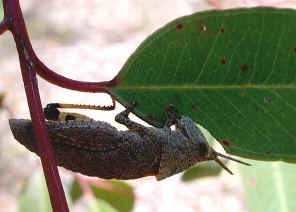
- Grasshopper nymph
Distinctive colours on leg inner surface
Leaf feeder
-
- Most grasshoppers species feed on leaf of grasses and trees. Some species feed on other vegetation including
flowers and stems.
Some even feed on dead eucalyptus leaves. Some species, under some
conditions, will migrate in a dense swarms form, known as locusts, bring large
damage to the crop.
-
- Grasshoppers
develop in in-complete
metamorphosis. We
recorded the life cycle of the Giant Grasshopper,
details please click on the link..
-
Classification:
- We
found quite a number of different species in this family. They are grouped in
four subfamilies and listed as follows;
-
 Subfamily Oxyinae - Moisture-loving Grasshoppers Subfamily Oxyinae - Moisture-loving Grasshoppers- Grasshoppers in this subfamily usually associated with water and
grasslands. We found only one species in Brisbane.
-
-
-
-
-
- Subfamily Catantopinae - Spur-throated Grasshoppers
-
 Tribe Catantopini - Spur-throated Grasshoppers Tribe Catantopini - Spur-throated Grasshoppers- Grasshoppers in this group are medium size, adults of some species are
wingless. Most grasshoppers found in Brisbane are belonged to this group.
-
-
-
-
-
 Tribe Cyrtacanthacridini
- Giant Spur-throated Grasshoppers Tribe Cyrtacanthacridini
- Giant Spur-throated Grasshoppers- Grasshoppers in this group are large to very large in size, included the
largest grasshopper in Australia.
-
-
-
-
-
-
 Subfamily Acridinae - Slant-faced and Band-winged
Grasshoppers Subfamily Acridinae - Slant-faced and Band-winged
Grasshoppers- This subfamily is a large group. Several locusts species are included.
Grasshoppers in this subfamily are usually medium in size. Some of them
produce buzzing sound when flight.
-
-
-
-
-
- There are some more grasshoppers yet to be identified in this Unidentified Grasshoppers
page, or find the grasshopper ID in our Grasshopper
Field
Guide
- Reference:
- 1. Insects
of Australia, CSIRO, Division of Entomology, Melbourne University
Press, 2nd Edition 1991, p382.
- 2. Grasshopper
Country - the Abundant Orthopteroid Insects of Australia, D Rentz,
UNSW Press, 1996.
- 3. A Guide to Australian Grasshoppers and Locusts - DCF
Rentz, RC Lewis, YN Su and MS Upton, 2003.
- 4. Family ACRIDIDAE - Australian Faunal Directory, Australian Biological Resources Study.
- 5. Northern
Territory Insects, A Comprehensive Guide CD - Graham Brown, 2009.
Back to top
[ Up ] [ Oxyinae ] [ Catantopinae ] [ Acridinae ]
| |
|