|
| |
Family Eurybrachyidae
- This page contains pictures and information about Dardus Wattle Hoppers that
we found in the Brisbane area, Queensland, Australia
-
 - Body length 6mm
-
- Dardus Wattle Hoppers are dark brown in colour. They are small in size. Their antenna base is exceptionally
thicken and look like small horn under each eye. The abdomen is bright red
but fully under cover by forewings. The forewings are dark brown, some
individuals have prominent transverse, slightly oblique, pale greyish-white spot before middle of costal
area. All legs are dark brown.
-
-
 

-
- They are found on young Black
Wattle during late winter in Alexandra Hill.
Nymphs and adults can be found on the same plants. Usually a number of them
can be found on one plants.
-

  -
- Above two pictures taken in the same place during mid-summer. We did not
see any nymph.
-
-


-
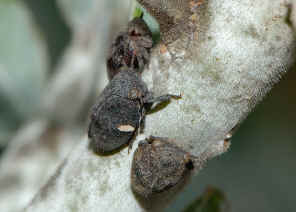
- On Mar 2009, we also found this little fellow on Queensland Silver
Wattle in Anstead Forest. Although one of them has the white dots on
each wing-cover, we believe they are the same species.
-


 -
- They usually found resting on young stems.
-
-


 -

  -
- The abdomen is bright red in colour.
-
Nymph
-
 
-
- The nymph also has this
two little horns under eyes and with two long tails. Nymphs and adults can be found on the same plants. Usually a number of them
can be found on one plants.
-
The Host Plants
- Black Wattle
-
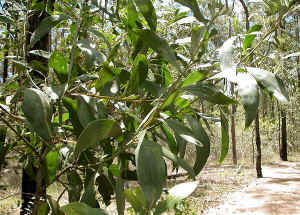

- Acacia leiocalyx subsp. leiocalyx, family Mimosaceae
-
- Queensland Silver Wattle

 - Acacia podalyriifolia
-
- Reference:
- 1. Genus
Dardus - Fletcher, M.J. and Larivière, M.-C. (2009 and
updates).
- 2. Species
Dardus abbreviatus (Guérin-Méneville, 1838) - Australian Faunal Directory, Australian Biological Resources Study
Back to top
[ Up ] [ Dardus Wattle Hopper ] [ Spider-face Wattle Hopper ]
| |
|


