|
| | Spider-face
Wattle Hopper - Gelastopsis insignis
Family Eurybrachyidae
- This page contains pictures and information about Spider-face Wattle
Hoppers that
we found in the Brisbane area, Queensland, Australia
-
 - Body length 9mm
-
- Spider-face Wattle
Hoppers are a bit
smaller in size than those Platybrachys species
that hat we found. They are brown in
colour with red abdomen. The brown colours vary from pale brown to dark brown
amount individual, but their patterns on wings are about the same. We
call them Spider-face Wattle
Hoppers because there are the patterns on its face mimicking jumper spider.
Details we discussed below.
-


 -
- Some adults of this species have the white strip on wings and some have not. The abdomen is
bright ping in colour, although hardly be seen, covered by wings when they are at rest.
-
   -
- Tens of them can be found on a small wattle tree. They seem prefer wattle
trees of medium size, about one to two meter tall, of tree trunk about
100-200mm in diameter. They are seldom found on vert large wattle tree trunk. They
are one of the most common planthopper species in Brisbane.
-


 -
- We found them in Karawatha Park in summer season. Karawatha Park is a
Eucalyptus forest with different species of gum trees and wattle trees.
-
 
 -
- We
found this planthopper on few different species of wattle trees. Once we recognized their
host plants, they are not difficult to be found. Group of them can be found on
the same plants.
-


 -
- We notice that some of them rested on stems with broken bark, where may be
easier for them to feed. However, we are not sure if those broken bark are the
result of their feeding or damaged by other animals.
-


 -
- Above two pictures were taken in Alexandra Hill bushland.
-
 
 -
- We also found them in Toohey Forest during early winter. Both adults and
nymphs were found on the same tree.
-


 -


 -


 -


Female and egg mass


 -
- Female abdomen enlarged and covered with white material. The planthopper
female is looking for a suitable site to lay eggs. Eggs are laid and covered with white waxy material on Wattle leaf, diameter 20-30mm. Pictures
taken in Karawatha Forest during mid summer.
-
-

 
- 1st instars, body length 3mm
-
- They are found on the bottom side of a Acacia leaf during late summer in
Alexandra Hill.
-
Nymph
-


-
- The adults and nymphs can be found on the same plant. The nymphs
usually rested on young green stems.
-


 -
- The nymph has a brown face, the spider face pattern is not obvious yet.
-


 -


 -
- We noticed one interesting behaviour of this planthopper. It mimics the
Jumping Spider.
-
 
 -
- They like to rest on stems of about 10mm diameter. When we came close, they
walked sideway and moved to the opposite side of the stem. This escape strategy
was quite effective on stems of 10mm diameter. The group of planthoppers
disappeared from our eyes in tenths of a seconds.
-
   -
- When we came more closer, they walk forwards or backwards along the stem.
They seldom change their facing direction unless walking backwards and blocked
by something. They jumped and flied away when we touch them.
-

  - The
hopper
Jumping spider, can be found on the same plant.
-
- With more observations, we found that sometimes we confused the planthopper
with the jumping
spider Zenodorus orbiculatus which are also very common on the same
host tree stems. Looked closer to the planthopper, we noticed the eyes pattern
on the planthopper's frons, which made us think it was a jumping spider.
-
 
 - The
hopper
Jumping spider that
can be found on the same plant.
-
- The planthopper may not look like a jumping spider in the human's eyes point of
view. Imagine if you were an ant or a jumping spider walking along the 10mm
thick stem, if you met the planthopper, most likely you will see the
planthopper face to face. At this angle, the planthopper looks like a jumping
spider.
-


 -
- This also explained why the planthopper only move sideway, forwards and
backwards but seldom turn around. Because if it turns, the mimicking fails.
-


 -
- The jumping-spider-mimicking may help the planthopper to avoid some
predators, such as ants and even the jumping spiders. We did see the Zenodorus
orbiculatus prey on ant.
-
- Together with our observations on another
planthopper Platybrachys vidua, its backwards movement and
eyes-pattern on wing tips to mimic larger animal. We speculate the
planthoppers adapted the backward movement first, and then eyes-pattern on
frons and on wing tips individually later in the journey of evolution.
-
- We have more discussions in our Mimicry
and Camouflage pages.
-
- We found this planthoppers on the following species of wattles.
-
- Black Wattle
-
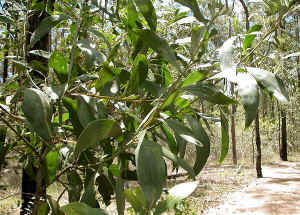

- Acacia leiocalyx subsp. leiocalyx, family Mimosaceae
-
- Black Wattle

- Acacia leiocalyx subsp. herveyensis, family Mimosaceae
-
- Golden Wattle

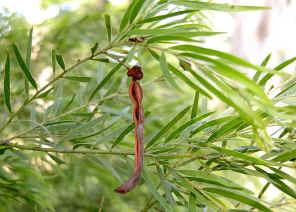
 - Acacia fimbriata, family Mimosaceae
Golden Wattle flowering in winter
-
- The planthoppers can also be found on Golden
Wattle.
-
- Reference:
- 1. Gelastopsis
insignis - Fletcher, M.J. and Larivière, M.-C. (2001 and updates).
- 2. Gelastopsis
insignis - Australian Biological Resources Study, Department of
the Environment and Heritage.
- 3. Maon
sinuatus - Fletcher, M.J. and Larivière, M.-C. (2001 and updates).
- 4. Revision of the Eurybrachidae (IV) - CONSTANT
JEROME, The Australian genus Gelastopsis KIRKALDY, 1906 (Hemiptera: Fulgoromorpha: Eurybrachidae),
2005.
Back to top
[ Up ] [ Dardus Wattle Hopper ] [ Spider-face Wattle Hopper ]
| |
|


