Tribe Exoprosopini - Stout Beeflies
Family Bombyliidae
This page contains pictures and information about Bee Flies in Tribe
Exoprosopini
that we found in
the Brisbane area, Queensland, Australia.

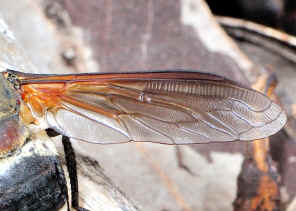
- In this Exoprosopini tribe, the beeflies have their wing vein Rs forks very close to cross vein r-m. They are large beeflies. They have stout body comparing with beeflies in other subfamilies. Their wings usually have hyaline and black patterns. Their body has contrasting stripes or brilliant black scales.
- Exoprosopini beeflies usually land on sandy floor or low plants on sandy soil. They are active under full sun. They will fly away if disturbed, but return to the same spot a short while later. Adult beeflies are nectar feeders. Females also feed on pollen for the development of eggs, i.e., they are the pollinators.
- Some species of Exoprosopini have the hilltop gathering habit. Sometimes a number of male can be found near the summit of isolated hilltops.
- Most of the Exoprosopini species have their larvae parasite on predatory and parasitic, ground-nesting wasps, such as Sphecidae, Pompilidae, Tiphiidae and Scoliidae. Some species extend to other ground-nesting insects.
Genus Ligyra
- Beeflies in genus Ligyra is large in size and have stout body. Their wings
are usually hyaline and some with dot on wing vein cross. There are two i-r
crossvein. The second i-r crossvein between R2+3 and R4.
- Common Ligyra Beefly


- Ligyra satyrus, body length 25mm
- This fly is large with orange-brown thorax. Its abdomen is shiny-black with a ring between thorax and abdomen. There are some white pattern at the end of its abdomen. They are quite common in Brisbane bush. More information and pictures of this Beefly can be found in here.
- Spotted Wings Ligyra Beefly


- Ligyra bombyliformis, body length 15mm
- Pictures taken in Karawatha Forest during mid summer. The Bee fly has dark fuscous abdomen cross by a wide band of pale yellowish hairs, and the brownish wings marked with eight small dark spots at the crossing-points of veins. Please also check this page for more information.
- Brown Ligyra Bee Fly

- Ligyra sinuatifascia, body length 15mm
- Pictures taken in Karawatha Forest during early and mid summer. Found them quite a few time in Rocky Circuit on the sandy footpath. Please check this page for more information.
Genus Balaana
- Beeflies in genus Balaana is medium in size. They are dark brown to
black in colours. Their wings are black-patterned. There is only one i-r
crossvein between R2+3 and R4.

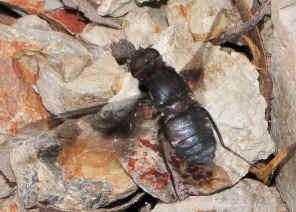

- Balaana latelimbata, body length 15mm
- We saw a few of those female resting on sandy path on hill top in Anstead Forest on Nov 2009. They are dark brown to black in colours. Their wings are black-patterned. Please check this page form more information.
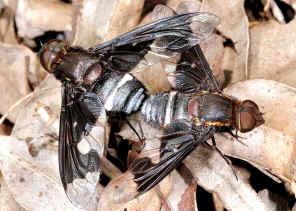


- Balaana abscondita, body length 15mm
- We found this mating pair in Anstead Forest on Oct 2010. They are dark brown to black in colours. Their wings are black-patterned. Please check this page for more infromation.
- Balaana Beefly III


- Balaana gigantea, body length 20mm
- Found a number of them in Karawatha Forest Rocky Circuit near the hill top on sandy footpath Nov 2008. They showed very strong territorial behaviour. After disturbed, they always flied back to the same spot and rest. When other flies came close, they always driven them away. Please click on here for more information.
Genus Pseudopenthes
- Short-winged Beefly


- Pseudopenthes fenestrata, body length 10mm
- This is a medium size black shiny beefly. Its wings are relatively short tinted with dark colour, with the hyaline spot near the wing base. Eyes and head are dark brown in colour. Thorax and abdomen are black and extremely shiny. There are the short white hairs along each side of thorax. There are the small white patches on each side of abdomen. Check this page for more details.
- Reference:
- 1. Insects of Australia, CSIRO, Division of Entomology, Melbourne University Press, 2nd Edition 1991, p 759.
- 2. Insects of Australia and New Zealand - R. J. Tillyard, Angus & Robertson, Ltd, Sydney, 1926, p364.
- 3. Bee Flies (Bombyliidae) - - by Giff Beaton, 2005.
- 4. An evolutionary radiation of beeflies in semi-arid Australia: systematics of the Exoprosopini (Diptera: Bombyliidae) - Lambkin CL, Yeates DK & Greathead DJ, Invertebrate Systematics, 2003
- 5. Life history of Ligyra satyrus (Diptera: Bombyliidae) - Yeates DK, Logan D, Lambkin CL. Australian Journal of Entomology. 1999. 38: 300-304.
- 6. A review of the Australian species of the genus Ligyra Newman (Hyperlonia Olim) (Bombyliidae : Diptera) - SJ Paramonov, 1967.
- 7. Northern Territory Insects, A Comprehensive Guide CD - Graham Brown, 2009.
- 1. Insects of Australia, CSIRO, Division of Entomology, Melbourne University Press, 2nd Edition 1991, p 759.

