|
| |
- This page contains pictures and information about Antlions in family Myrmeleontidae
that
we found in the Brisbane area, Queensland, Australia.
-
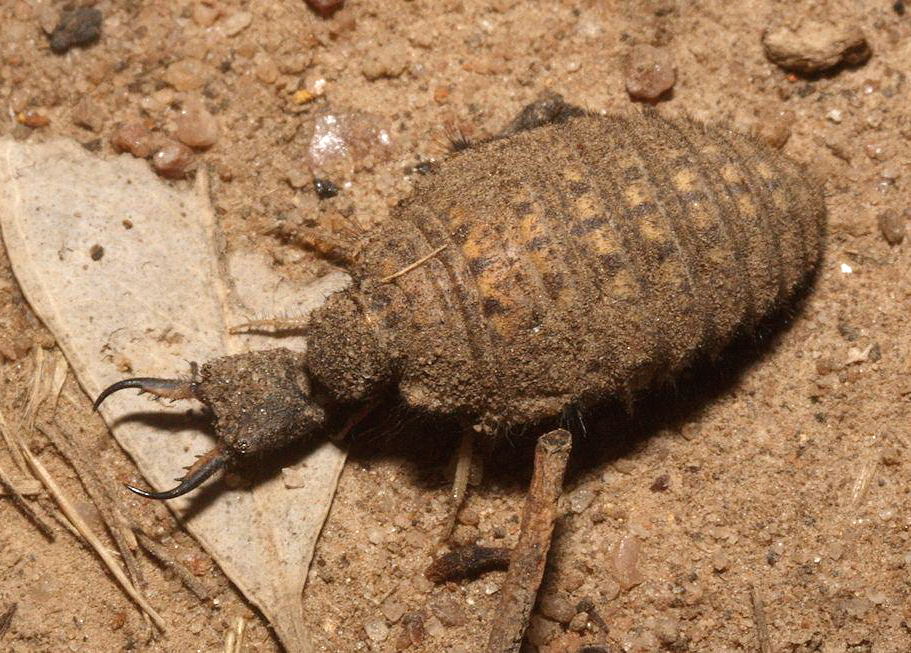 - Antlion - Lacewing Larvae
Photo thank to Trevor Jinks
-
- Antlion is the common name given to the larvae of some
species (genera Myrmeleon, Callistoleon and closely related genera) in this family. The
larva
builds sand traps to trap
the ants walk by.
-
 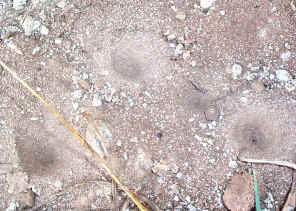
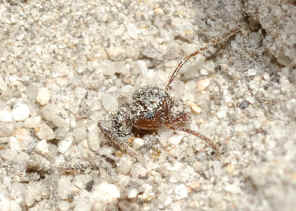
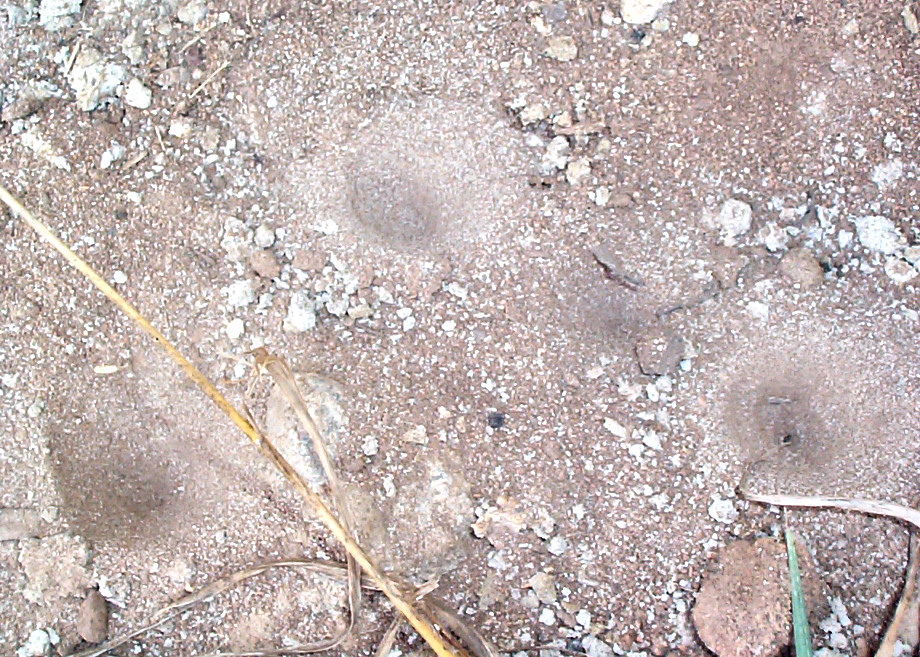
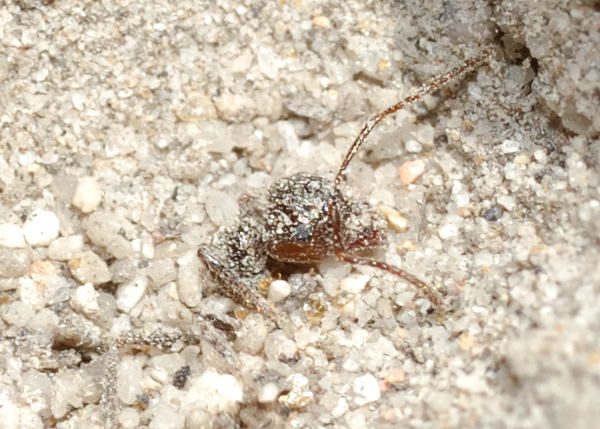
- Antlion - larva, body length 5mm
Sand traps, diameters 40mm
The ant prey
-
- The sand traps are about 40mm diameter. The Antlion sit at
the middle of the trap, covered by loose sands. When an ant or other small
insects walks inside the trap,
some sands fall into the centre alert the Antlion, then it flicks more sands
to the ant and cause the 'land sliding'. The ant then fall towards the centre
and the Antlion attacks the ant by its long jaws.
-
- Some other species larva burrow freely in sand or live on tree as predators.
They pupate in soil with cocoon covered with sands.
-
- Eggs are laid singly and being scattered in dry soil.
-
- Myrmeleontidae is the largest Lacewings family. Adults in this family have short antenna which thicken towards the tips, ocelli
absent. They are medium
to large size with long wings. Their abdomen is long and slender. Most of them are predator although some feed on
pollen. Myrmeleontidae is the largest Lacewings family
in Australia.
-
Subfamily Myrmeleontinae, Myrmeleontini - Antlions
- Orange Antlion
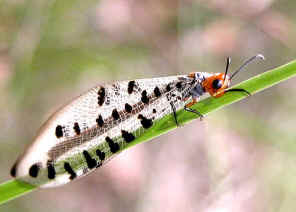
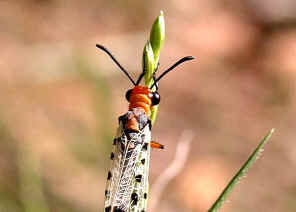
- Callistoleon erythrocephalus, body length 40mm
- Pictures taken in Alexandra Hill during early summer 2004. The lacewing has
bright orange colour head and thorax with spotted wings. Their larvae are true
Antlions, build sand traps on ground. More pictures and information please
click on here.
-
-
- Common Brown Antlion
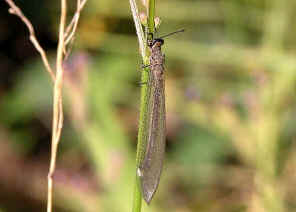
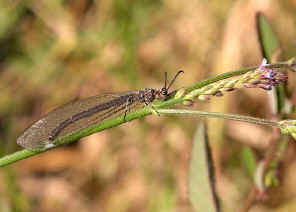 - Myrmeleon
acer, body length
40mm
- Pictures taken
near Bulimba Creek in Wishart during late summer. Their larvae are true Antlions, build sand traps on ground. More
pictures and information can be found in this page.
-
Subfamily Myrmeleontinae, Dendroleontini
- Dendroleontini is the dominant group of Australian myrmeleontids.
-
- Angular-wing
Lacewing
-
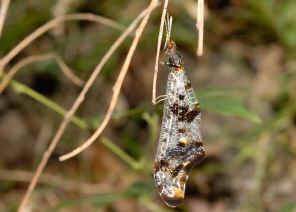
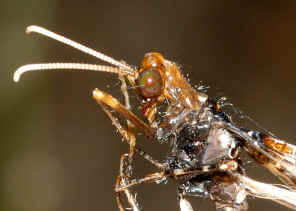
- Periclystus circuiter, body length 40mm
- This lacewing has wings in irregular shape with dark brown
spot patterns. The patterns becomes purplish black under the sun. It is easy to distinguish this lacewing by its wings. Tts abdomen is dark brown in colour with two white rings and orange tip. We
have more information and pictures in this page.
-
-
- Mottled Brown Lacewing
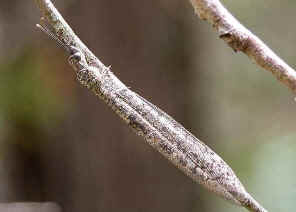
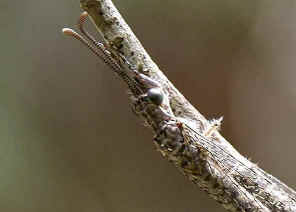 - Austrogymnocnemia pentagramma,
body length 40mm
- We
found them a few times, always on stems about 1-2 meters above ground. Please
check this page for more information.
-
-
- Banded Lacewing
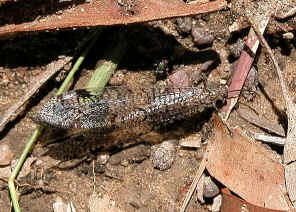 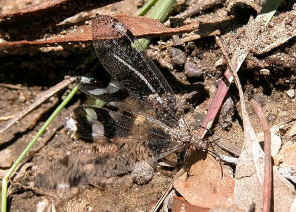
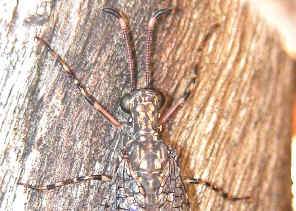
- Glenoleon pulchellus, body length 40mm
- We first found this adult
Lacewing during summer in Alexandra Hill bushland. There are quite a
number of them in a small area. All of them hiding under fallen tree or stem close to
the ground. When disturbed they fly slowly away to another hiding place.
Because of their camouflaged colour, they are difficult to be seen if not
move. They can
also be found in Mt Cotton bushland and Karawatha Forest. More pictures and
information can be found in this page.
-
-
- Brown
Line Lacewing
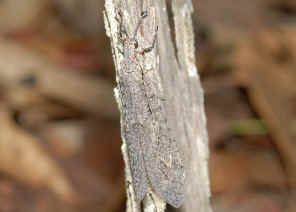 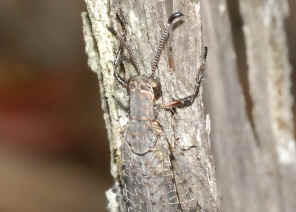 - Glenoleon
berthoudi, adult, body length 40mm
- This lacewing has
a thin brown line on front wings. It is easy to distinguish this lacewing by its wings. As most other lacewing species, this lacewing flies
clumsily and slowly, just about the ground. It rather finds a stick or stem to rest on and does the
camouflage. Please check this page for more
information.
-
-
- Slender
Brown Lacewing
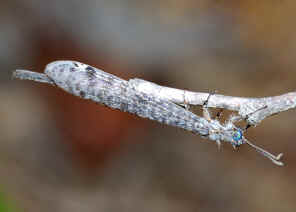
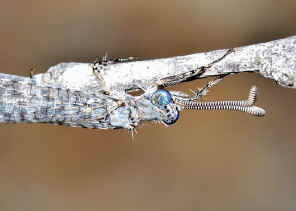 - ?
Froggattisca tipularia, adult, body length 40mm
- This Antlion
adult was found in Karawatha Forest. It mimicked part of the dry stem. It did
not move a bit even when we came very close. More pictures and information
please click on here.
Subfamily Myrmeleontinae, Distoleontini
- Mottled Black Lacewing
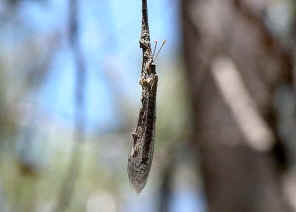
 - Distoleon somnolentus,
body length 40mm
- This lacewing adult has the slender body and narrow
mottled wings. It black antennae are long, segmented and with slight clubbed
pale apex. This lacewing adult was found in Karawatha Forest. It mimicked part of the dry stem. It did
not move a bit even when we came very close. Please check this page
for more infromation.
-
- Reference and Link:
- 1. Insects
of Australia, CSIRO, Division of Entomology, Melbourne University
Press, 2nd Edition 1991, pp 541.
- 2. Insects of Australia and New Zealand - R. J. Tillyard, Angus &
Robertson, Ltd, Sydney, 1926, p323.
- 3. A
Revision of the Australian Myrmeleontidae (Insecta: Neuroptera). I.
New, T.R. (1985) Introduction, Myrmeleontini, Protoplectrini. Aust. J.
Zool. Suppl. 104: 1-90.
- 4. A Revision of the Australian Myrmeleontidae (Insecta : Neuroptera) II.
New, T.R. (1985) Dendroleontini, Aust. J.
Zool. Suppl. 105: 1-170.
- 5. A
Revision of the Australian Myrmeleontidae (Insecta: Neuroptera). III.
New, T.R. (1985) Dendroleontini. Aust. J.
Zool. Suppl. 105: 1-159.
- 6. Lacewings - Queensland Museum, 2011.
[ Up ] [ Lacewings, Antlions and Owl Flies Biology ] [ Osmylidae ] [ Mantispidae ] [ Hemerobiidae ] [ Chrysopidae ] [ Nymphidae ] [ Myrmeleontinae ] [ Stilbopteryginae ] [ Ascalaphidae ]
| |
|