|
| |
Order Neuroptera
- This page contains pictures and information about Mantid Lacewings in Family Mantispidae
that we found in the Brisbane area, Queensland, Australia.
-
-
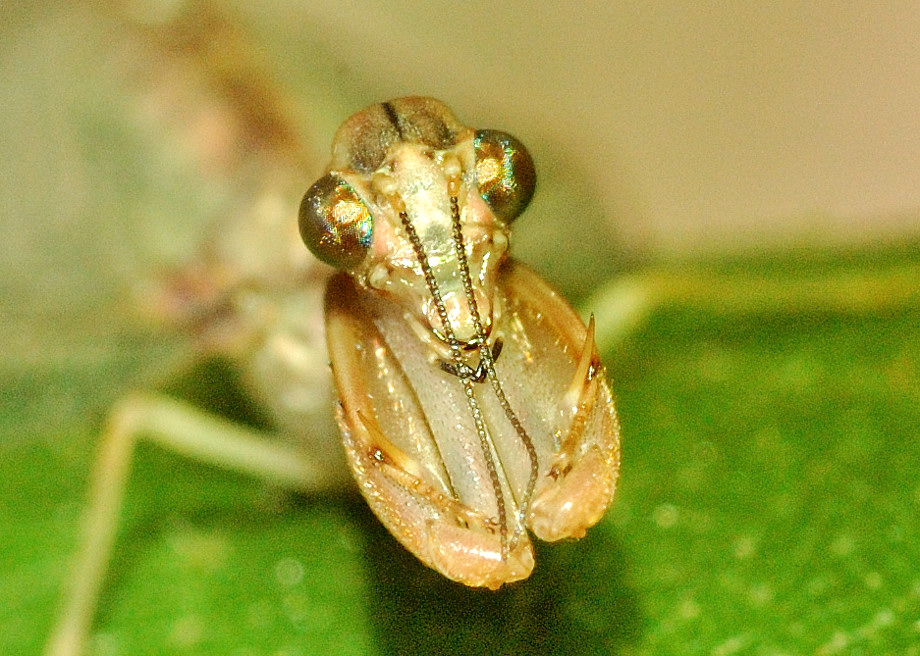
- The Mantid Lacewings are from small to medium side. They are sometimes known as Mantis
Flies. Their raptorial forelegs, triangular head and elongated prothorax look like
Preying Mantid but they have the
typical clear membranous wings. Their antennae are short and sometimes
thickened.
-
- Their raptorial forelegs are powerful for predating. The coax is extremely
elongated. The femur bears spines long and short along ventral margin. Their
last two pairs of legs are long for fast prey attack action.
-
- They can sometimes be found in bushlands. They are active at
night. Sometimes they were attracted to house by window lights.
-
- Adults are active predators, chasing
prey with their spiny forelegs. Usually they are pinkish-brown in colours but some
species are brightly coloured. Some mimic social wasps.
-
- Larvae are parasitise,
some parasite on spider egg sacs and some on social wasp larvae.
They are hardly be seen.
-
-
- Mantid Lacewing I, Mantis Fly
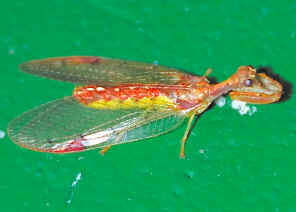
- Ditaxis biseriata, body length 30mm
- This Mantid Lacewing has the pinkish wings each with a pink
pterostigma. We found the above lacewing in our backyard. This Mantid Lacewing
is common in Brisbane. Please check this page
for more information.
-
-
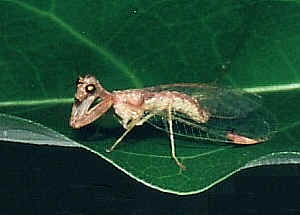
- Mantid Lacewing II
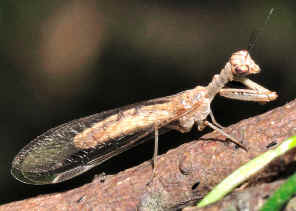
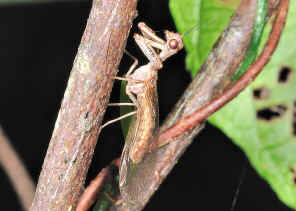
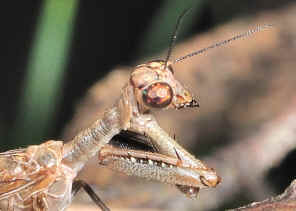
- Theristria discolor, body length 30mm
- Mantid Lacewings are active predators, chasing
prey with their spiny forelegs. This Mantid Lacewing is pinkish-brown in colours.
Please check this page for more
information.
-
-
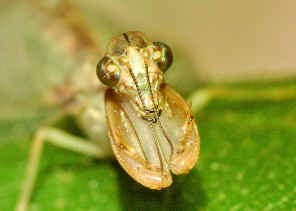
- Mantid Lacewing III
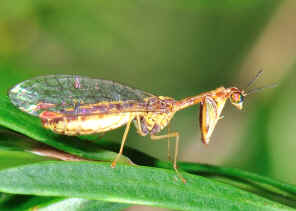
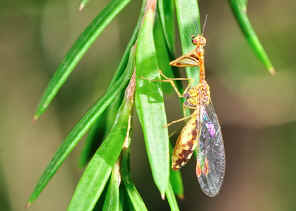
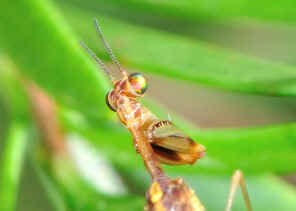 - Austromantispa imbecilla, body length 12mm
- Found this small Mantid Lacewing in Karawatha Forest on Dec 2010.
It were flying and stopped on plant in front of us. Please check this page
for more information.
- Reference:
- 1. Insects
of Australia, CSIRO, Division of Entomology, Melbourne University
Press, 2nd Edition 1991, pp 533.
- 2. Insects of Australia and New Zealand - R. J. Tillyard, Angus &
Robertson, Ltd, Sydney, 1926, p319.
- 3. Wildlife
of greater Brisbane - Queensland Museum, p99.
- 4. Ditaxis biseriata
- Australian Faunal Directory, Australian Biological
Resources Study.
- 5. A revision of the Australian Mantispidae
(Insecta : Neuroptera) with a contribution to the classification of the family. I. General and Drepanicinae - KJ Lambkin, Australian Journal of Zoology Supplementary Series 34(116) 1 - 142,
1986.
- 6. A revision of the Australian Mantispidae
(Insecta : Neuroptera) with a contribution to the classification of the family. II.* Calomantispinae and Mantispinae - KJ Lambkin, Australian Journal of Zoology Supplementary Series 34(117) 1 - 113,
1986.
- 7. Northern
Territory Insects, A Comprehensive Guide CD - Graham Brown, 2009.
- 8. Lacewings - Queensland Museum, 2011.
[ Up ] [ Lacewings, Antlions and Owl Flies Biology ] [ Osmylidae ] [ Mantispidae ] [ Hemerobiidae ] [ Chrysopidae ] [ Nymphidae ] [ Myrmeleontinae ] [ Stilbopteryginae ] [ Ascalaphidae ]
| |
|
