|
|
Evening Brown Butterfly - Melanitis leda
FAMILY NYMPHALIDAE
- This page contains information and pictures about Evening Brown Butterflies in the Brisbane area, Queensland, Australia.
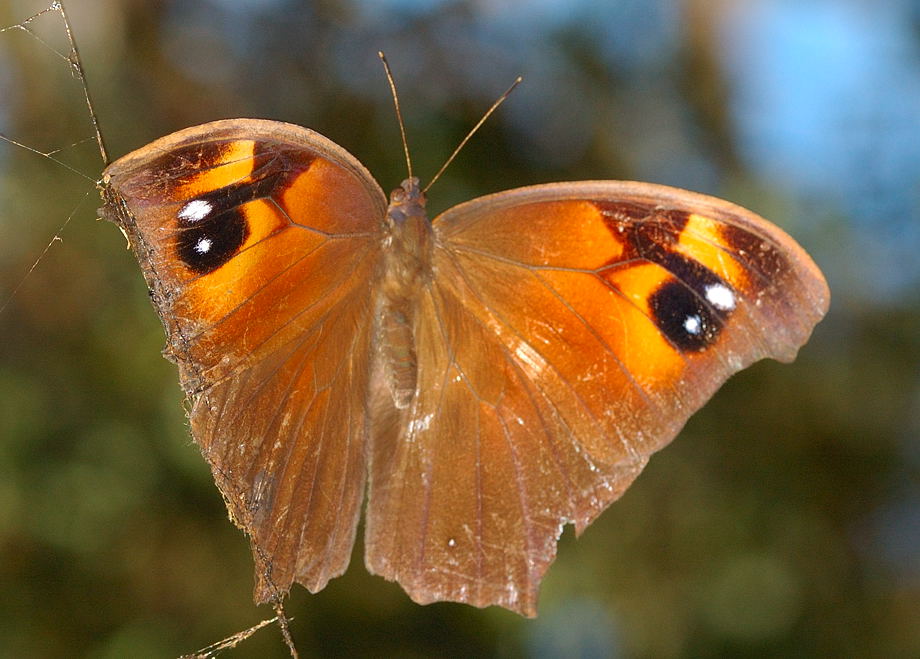
- Wingspan 80mm, get caught on spider web
- The Evening Brown butterflies can be seen flying in the bush during evening before complete darkness. They are the most common butterfly in Brisbane bushes. In the day time they rest on the forest ground amongst dry leaves. They can hardly be seen unless disturbed. They active in the evening.

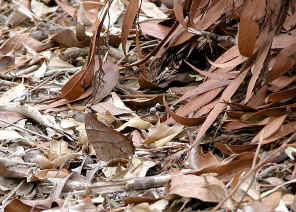

- During the day when we are pass through dense vegetations, if there are some large brown insects fly away and rest a few meters away, most likely they are the Evening Brown butterflies. They fly with a rapid and powerful flight less than a meter above ground.


- The Evening Browns are still active in Brisbane winter. Sometimes they are the only large insects we saw during mid-winter bush-walking. Their talent of activeness in cool evening may help them to cope with the cold winter as well. The Evening Brown's body is covered with dense short hairs. This may help to keep their body temperature for they are active at night and in winter.


Colours and patterns vary between individuals
- The butterflies are brown in colour and looks like a dead leaf. The underside wings are marked with small eyespots pattern, which confuse the predators not to attack the butterfly body. The butterfly has two colour forms. In winter they have less eyespots pattern on the bottom side of their wings and darker in colour.


- Dry season form


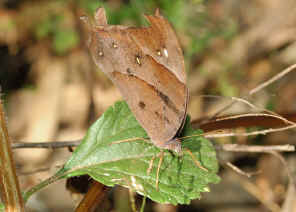
- Dry season form

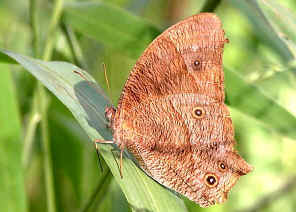

- Wet season form


- Wet season form


Caterpillar


- The Evening Brown caterpillar body is green with white spots. There are a pair of dark red horns on its dark green head, and a pair of smaller green horns on its tail.


- Host plants are many types of glasses. Female lays eggs on host plant Cat.......Caterpillar
- The butterflies lay eggs on the leaf of tall grass, which is the food of their caterpillars. The caterpillars feed on different types of grasses, including Kangaroo Grass Themeda australis and rice plants. They are considered as pest to rice farmers.


- Preparing the pupate site Above to pupate, becomes 'J' shape Pupa
- The Evening Brown caterpillar lives on the underneath of the grasses and pupate there. A few hours before pupating, the caterpillar turned into a 'J' shape. The pupa was green in colour. It hang by silk from the grass. It stayed motionless as pupa for about 10 days, then the adult butterfly emerged from the pupa.


- Butterfly emerged
- The above picture shows a Evening Brown is just coming out from its pupa. The butterfly is pumping blood into its wings to extend them. It has to waits for its wings to become hard before it can fly. This may take a few hours. The butterflies may stay in the area for one or two days. Then the Evening Brown flies to find its partner and start their new life cycle.
- However, not all pupae will turn into butterflies, they may be parasited by Wasps or Tachnid Flies and never turn into a butterfly.


Evening Brown Butterfly Life Cycle


Pupa Location
The Evening Brown Butterfly pupa is always found hanging under the long grass. They are covered by dense vegetations and hard to be noticed.


Few years ago we found our first Evening Brown pupa. It was hiding in the grasses. When we took the pictures we thought we are very lucky because the sun light just passed all the grasses and shining onto the pupa, which gave the perfect lighting for the photo.
Later we found another Evening Brown Pupa and found that our luck was still there. The pupa was shine directly by the afternoon sun light. A pupa photo with good lighting was just easy to take.
Then we found that almost all Evening Brown Pupa were shined by the afternoon sun light. We started to realized that this could not be our luck. It could be the Evening Brown Caterpillars had carefully chosen their pupa position.
- Reference:
- 1. Insects
of Australia, CSIRO, Division of Entomology, Melbourne University
Press, 2nd Edition 1991, p897.
- 2. Insects of Australia and New Zealand - R. J. Tillyard, Angus & Robertson, Ltd, Sydney, 1926, p461.
- 3. Create More Butterflies - by Frank Jordan and Helen Schwencke, Earthling Enterprises, 2005, p18.
- 4. The Complete Field Guide to Butterflies of Australia - Michael F Braby, Australian National University, CSIRO 2004, p150.
[ Up ] [ Evening Brown ] [ Orange Ringlet ] [ Common Brown Ringlet ] - 2. Insects of Australia and New Zealand - R. J. Tillyard, Angus & Robertson, Ltd, Sydney, 1926, p461.
