|
| |
Family
Geometridae
- This page contains pictures and information about Emerald Moths and Caterpillars in
subfamily Geometrinae that we found in the Brisbane
area, Queensland, Australia.
-
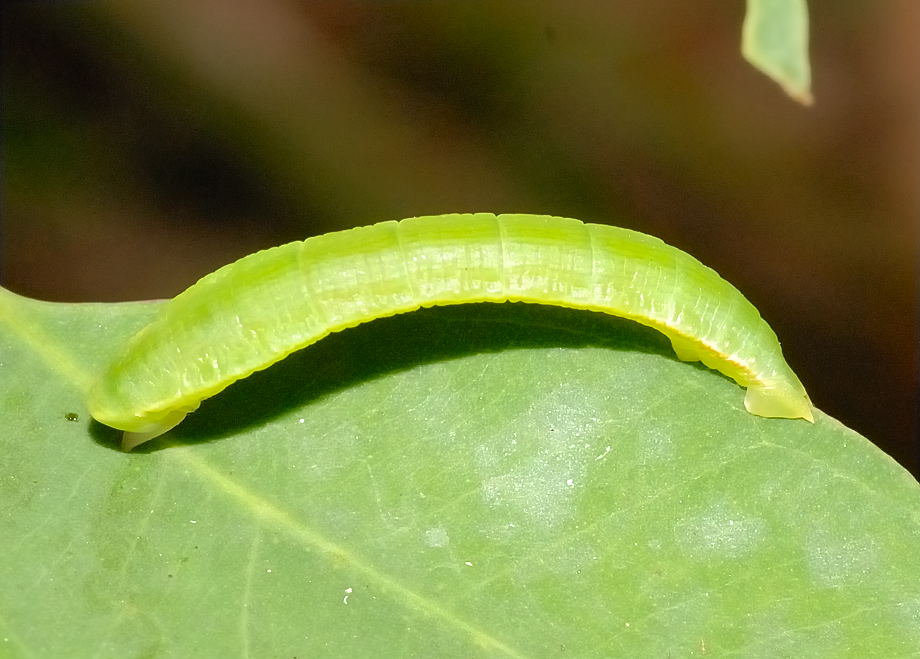 - Caterpillar of Hypodoxa sp., a typical Geometrinae
looper.
-
- The mature caterpillars in this subfamily have only one pair of ventral
prolegs. They move forwards only in the looper fashion.
-
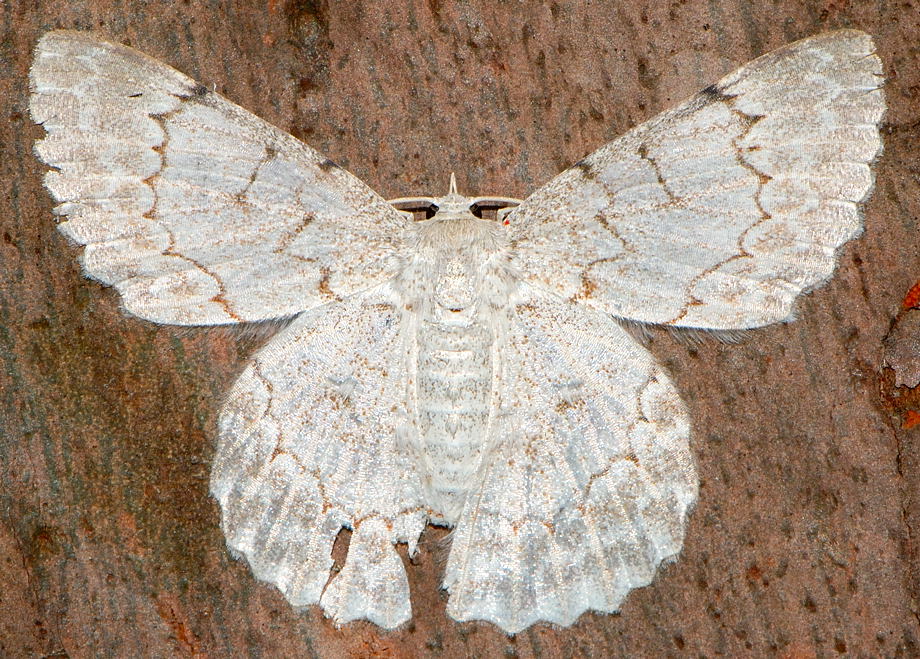
- Adult Emerald Moths fly weakly at night. There are two group in this
subfamily. The first group, include the Anisozyga sp., they are
slender body and usually green in colour, hence the common
name Emeralds. Others group are grey in colour with stout body. All of them
depend on their cryptic coloration or pattern for protection. They rest with
their wings fully outspread and their wing patterns matched closely to the
background.
-
-
- White Spread-winged Moth
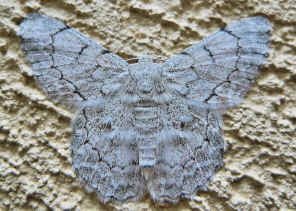 - Pingasa chlora, wingspan
50mm, female, female, male
- The
moths have camouflaged wing patterns. When they rest on tree bark, they
are hardly been seen. These patterns are wavy lines extend across both fore and
hind wings. Unlike other species, this moth rests with front wings up forward, separated
with the hind wings. For
more information and pictures please click on here.
-
-
- Common
Brown Looper Moth
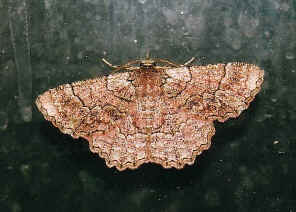
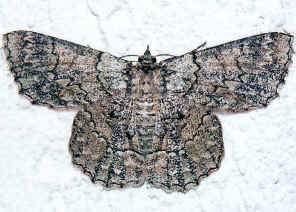
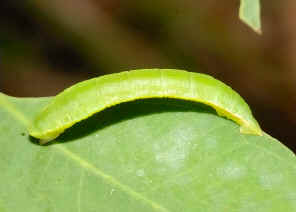 - Hypodoxa muscosaria, wingspan 40mm,
male, female, caterpillar
- The about 1st pictures taken in mid-winter, the moth rest on our window glass
in a cool night. Their caterpillar is green in colour resemble
plants stem. Most information and pictures in this page.
-
-
- Green Looper Moth
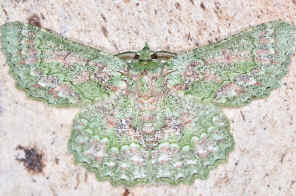
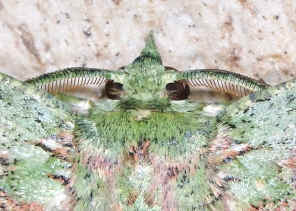 - Hypodoxa bryophylla, wingspan 30mm, male
- Photos were taken on Sep 2010 in Ford Road Conservation Area. It was resting
near the base on a large gumtree trunk. Please check this page
for more information.
-
-
- Redlined Looper Moth
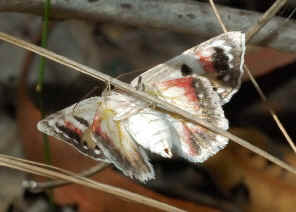
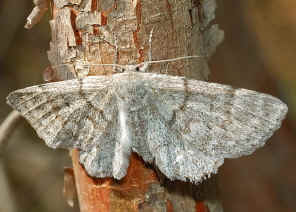 - Crypsiphona ocultaria, wingspan 40mm
- Pictures taken on Nov 2007 in Karawatha Forest. The bottom size of the moth
is more interesting. There are the red and black patterns. More infromation
and pictures can be found here.
-
-
- Gumtree Bizarre Lopper Moth
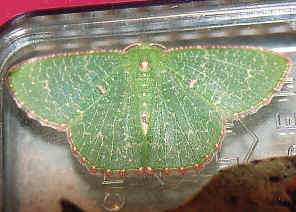 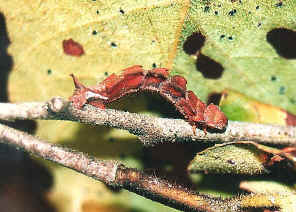 - Anisozyga metaspila, adult male, wing span 30mm, caterpillar
length 20mm
- We found this caterpillar on early summer. This caterpillar camouflages as part of the stem. We only know it was a
looper caterpillar when it start to walk away. The caterpillar is brown
in colour. It body surface is covered with small hard round bumps. The adult
moth is basically green, with lacy white spots on the wings. More pictures and
information please find in this page.
-
-
- Wattle Bizarre Lopper Moth
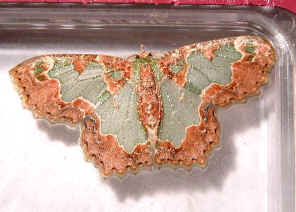 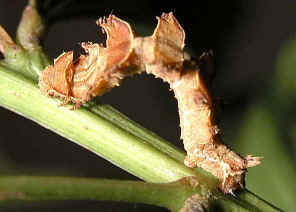 - Anisozyga pieroides, adult female, wing span 30mm, caterpillar
length 20mm
- The
small caterpillar was found on a Acacia leaf. The picture show a female
Bizarre Lopper Moth. It is green in
colour with brown wing edges. The male moth is green and
white in colour, look quit different. More pictures and information please
click on here.
-
-
- Red-dotted Emerald Moth
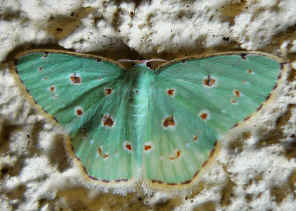
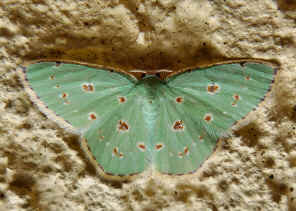 - Comostola laesaria, wingspan 20mm
- The moth is green in colour with red dots on each wings. Photos were taken
on Apr 2010 on the wall outside my office. It was attracted to the wall by
the fluorescent lamp there. Please check this page
for more information.
-
- Reference:
- 1. Moths
of Australia - I. F. B. Common, Melbourne University Press,
1990, p371.
- 2. A
Guide to Australian Moths - Paul Zborowski, Ted Edwards, CSIRO
PUBLISHING, 2007, p137.
- 3. Northern
Territory Insects, A Comprehensive Guide CD - Graham Brown, 2009.
- 4. GEOMETRINAE in Australia - Don Herbison-Evans & Stella Crossley, 2011.
-
[ Up ] [ ENNOMINAE ] [ OENOCHROMINAE ] [ GEOMETRINAE ] [ STERRHINAE ] [ LARENTIINAE ] [ Unknown Loopers ]
Back to Top
| |
|