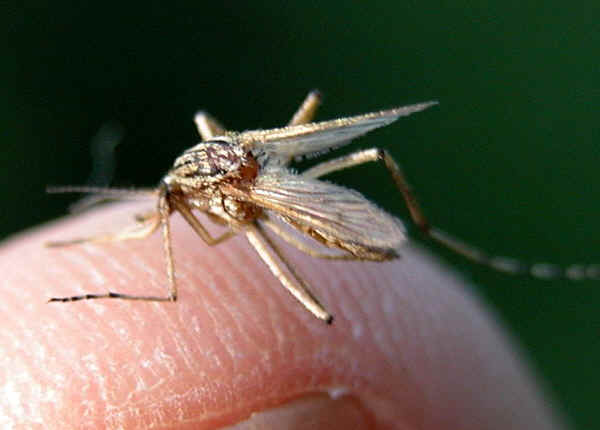
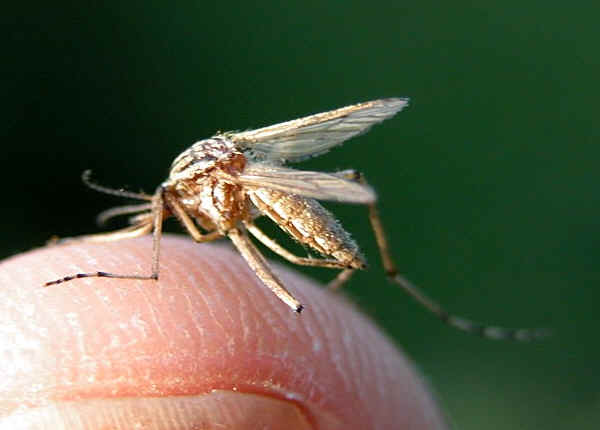
Mosquitoes - Family Culicidae
This page contains pictures and information about Mosquitoes that we found in the Brisbane area, Queensland, Australia.

- Body length 5mm
- Mosquitoes could be the most encountered insects when we go for bush-walking and taking insect photos. They usually found us first before we found them. However, only a few species of mosquitoes suck human blood. Some species suck blood from other vertebrate animals, such as birds, reptiles and frogs. Some species do not suck blood at all.
- For those blood-sucking species, only the females suck blood. They require a blood meal before their eggs can mature. They suck blood using their elongated mouth-parts to pierce the host's skin. Males do not suck blood and usually have the slender body.
- The mosquitoes can be distinguished from flies of other families by their scales on wing veins. Most of them also possess a long piercing proboscis.
- Their larvae are all aquatic. The slightest accumulation of water after rain suffices for some species.
- Salt Marsh Mosquito
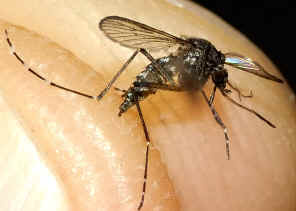
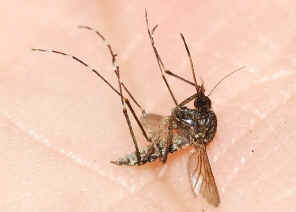
- Ochlerotatus vigilax (Aedes vigilax), subfamily CULICINAE, body length 4mm
- This is one of the common mosquito that we encountered during bush-walking. It will come to you and suck your blood during any time during day, in sunny or shaped area. Please check this page for more information.
- Grey-striped Mosquito

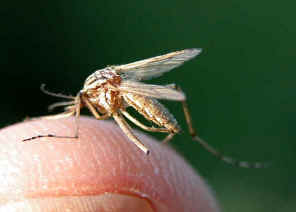
- Ochlerotatus vittiger (Aedes vittiger), subfamily CULICINAE, body length 6mm
- We have only this piece of information about mosquitoes in our web site, although they were the most often encountered insects when we were in the bush looking for other insects.
- Thank to Roy Durre for sending us email to correct the ID of this species.
- Reference:
- 1. Ochlerotatus vittiger - The Grey-striped Mosquito - Insects of Townsville, Australia - Graeme Cocks, 2004
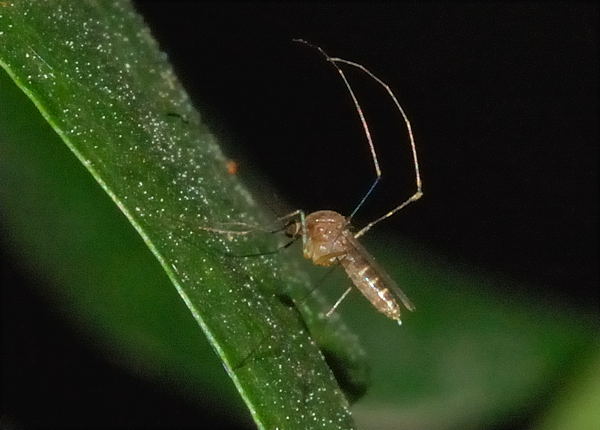
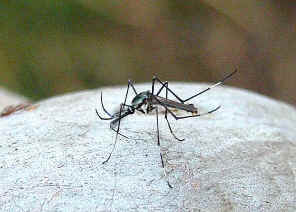
- Mosquito
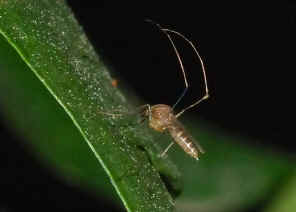
- ? sp., subfamily CULICINAE, body length 6mm
- Predatory Mosquito
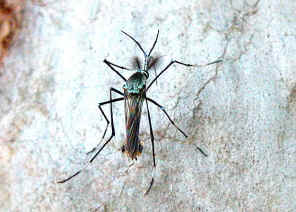
- Toxorhynchites speciosus, Subfamily TOXORHYNCHITINAE, body length 12mm
- We some time found this fly resting on leaf or tree trunk. Its wing patterns mimic a head on its end tip. This is quite a large mosquito. Notice its plumose bushy antenna, this shows that the mosquito is a male. More information and pictures please click on here.
- Reference:
- 1. Insects of Australia - CSIRO, Division of Entomology, Melbourne University Press, 2nd Edition 1991, p743.
- 2. Insects of Australia and New Zealand - R. J. Tillyard, Angus & Robertson, Ltd, Sydney, 1926, p350.