-
| |
Family APIDAE
- This page contains pictures and information about Honey Bees that we found in
the Brisbane area, Queensland, Australia.
-
 - Body length 15mm
-
- Honey Bees are introduced domesticated insect, however we found many feral colony in
Brisbane. They are social insects live in very large colony. Worker bees
are golden brown in colour with hairy legs, thorax and head. Look carefully
will find that most part of their eyes are hairy too.
-

  -
- There are the dark brown
and yellow bends on their abdomen. The queen bee looks similar to the workers but slightly
larger in size. Honey Bees will vigorously defend their nests if disturbed.
-
 

-
- Honey bees visit all types of flowers for the nectar and pollen.
-


-
- They have long tongues which allow them to reach the nectar in tubular
flowers. Of course they feed on shallow flowers as well.
-
 

-
-


-
-


-
Honey Bees compete with Australian Native Bees
 

-
- Above pictures show the introduced Honey Bees compete with native
bees on collecting nectar.
-
Honey Bee Colony
-
 

-
- A feral Honey Bees colony found in a living tree trunk in Moorooka, Brisbane.
Hundreds of bees per second passing me when I take the above picture. They do
not have problem with me when I was standing about two meters away. However,
when I moved a bit closer, I started to hear very loud humming noise. I
understood that those bees were giving the warning signal. I did not want
to come more closer for I knew what will happen if I did. I smelled the honey even
meters away.
-
 
 -
- In Brisbane we can see worker Honey Bees visit flowers in search of pollen
all year round. Besides collecting food, worker bees carry out many
different tasks include building the nest,
protection, ventilation, cleaning, look after the young and attend the
queen.
-


 -
- Besides nectar and pollen, Honey Bees also collect water and resin. We often
see some bees collecting water on the creek. Wherever there is the tree hole, we
see bees collecting resin to build their nest.
-
Honey Bees Swarming

-
- The above pictures were taken on Oct 2011 in Carbrook Wetland. Honey Bees
Swarming is the reproduction of Honey Bee colony. In reproduction season, a
queen bee leaves the original colony with a large group of worker bee
followers. The number of bees can be up to thousands. During the move, the group forms a swarm clusters usually hanging off of tree branch. They will move on and find a suitable nesting location in a day or two.
Swarming bees are usually not aggressive unless provoked,
Honey Bees Moving Nest
 
 -
- The next day after a thunderstorm, we found a bee nest in a fallen gum tree.
The nest was in a tree hole, it became wide open because the tree hole had been
broken, some nest internal parts and honey were found on the ground. This was a
rare change to have a look inside a bee nest.
-
 -
- The bees were very busy and did not care about our peeking. They all were
carrying something away from the nest. We believed they might have found a new
nest and were moving into it.
-
Honey Bee Farm


 -
- Notice in the last photo above the some bees formed a circle and watching
a bee performing waggle dance.
Honey Bee Predators
 -
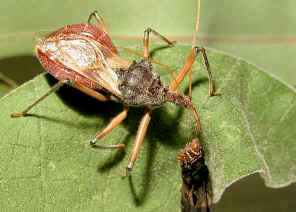
- Although bees have their power sting weapon, they do have some predators,
such as the Rubber
Fly, Assassin
Bug and Scorpion Fly. The above picture shows a Rubber Fly feeding on a honey bee.
[ Up ] [ Honey Bee ] [ Stingless Bee ]
| |
|


